- Meet new people. This is a fallacy – you could meet new people by walking around the block, but nobody ever does that.
- Try new food. This is also a fallacy – you could try something new at your favorite restaurant, but nobody ever does that.
- Buy new things.This is becoming a fallacy – with globalization, you can find the same goods everywhere (and they were all made somewhere else).
- Learn new things. Fallacy – I’ve read the average college graduate reads one book per year. If you want to learn new things, books are much easier and cheaper than travel.
- Get bragging rights back home. That was why we were in England.
This is what the guidebook had to say about English breakfasts: "Breakfast is liable to be some combination of eggs, fatty bacon, sausages, grilled tomatoes, fried mushrooms, baked beans, toast, and cereal. Tourists tend to enjoy [this] because they don't eat such things at home. If they did they would die." Now we're always up to a culinary challenge, but Dawn was under doctor's orders to avoid dairy and tomatoes, and I wasn't eating meat, so we were trying to be gluttonous without being rude. The breakfast nazi was not helpful; she just barked from the kitchen, "What do you want?" Dawn asked, "What do you have?" but she replied, "What do you want?" I volunteered that I was vegetarian, but she said, "We don't do that here." That stumped both of us. Fortunately another border came to our rescue, who said, "I'd like a fried egg and toast, please." That seemed to be okay, so we ordered the same. For the next two weeks, our breakfast consisted of fried eggs and toast. Dawn tried bacon one day but British bacon is very different than American bacon - think more grease, and more salt. You could say one bite "cured" Dawn.
 Had we seen the news or read a newspaper, we would have known the heat wave had just snapped and the high for the day was 11 degrees (that's about 50 to you Colonials.) However, we pointedly avoid news on vacation, so it was with great ignorance that we went out in t-shirts and jeans and waited for two and a half hours to see the changing of the guard, only to be massively disappointed by the whole pomp and circumstance. Think of watching people arrive at work, and you get the idea. Buckingham Palace, I need to mention, is nothing to get excited about, at least not from the outside-it looks like a Wal-Mart without a parking lot. The Queen was in residence so we didn't get to see the inside. After changing into full winter gear, we ate lunch at a restaurant near the hotel, which consisted of unidentifiable vegetables baked in some kind of cheese.
In the afternoon, we followed the guidebook to Temple Church, which supposedly was just past an unmarked door on Fleet Street. Naturally, the door was locked. Not to be dismayed, we spent an hour circling the area before finding another way in. The guidebooks mentioned the church was built by a secret society of knights; apparently the church was a secret as well. Still, it was well worth the effort - the church was beautiful, and there was nobody else inside. We stayed a while and then headed down the street to St Paul's Cathedral, which was supposed to be even more magnificent. We don't know - they were closing as we arrived, and we never went back.
 To get back to the hotel, we took our first double-decker bus ride. I don't know if it was the giddying height of our perch in the front row of the top, or that we were passing so many historical landmarks along the route, or the excitement of being in a new town, but for whatever reason, we completely missed our stop. Not "oh that was our stop" - no, by the time we thought to ask the driver where Victoria Station was, he went into hysterics. When he had recovered, he said he was almost at the end of his route, and so he would just turn around and take us back. When we got back to the hotel, we wandered around the area and found what any good tourist needs: A 24-hour supermarket. We bought some chocolate chip cookies and soy milk (which, it turns out, is pretty good) to finish off the evening.
On Day 2, our first stop was Westminster Abbey. (Actually it was supposed to be Greenwich, but on the tube we completely revamped our plans.) Now bear in mind - since it had completely slipped ours - that this was a Sunday, and Westminster Abbey is a church. And so it was quite awkward when we found out the queue we were standing in was for Sunday services, and Easter Sunday no less. (We thought everyone looked a little dressy.) It's been about fifteen years since I last sat through services, and now I vividly remember why. We sat next to an airline stewardess from Toronto, and so got to hear all the latest news about SARS as well, which really helped to increase the comfort level.
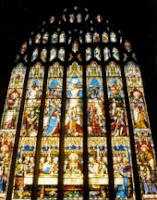 I must admit that I have a love-hate relationship with churches. They are inspiring, spectacular, and amazing, but after about fifteen minutes, I start to wonder who paid for them, and whether the money could have been spent elsewhere - building hospitals, schools, etc. But then I start to think how much poorer our lives would be without these grand monuments, so maybe it was a wise investment. After a while, such circular thinking usually gives me a headache.
After services, two hours later, we headed for Trafalgar Square, which was completely covered with scaffolding, children, and pigeons, so we didn't stay long. We wandered through the National Gallery and looked at paintings by Thomas Constable, who painted scenes from Suffolk County. Since we weren't going to Suffolk County, this was the next best thing. (Think Thomas Kinkade without the gross commercialism.) Next we walked down The Mall back to Buckingham Palace. On the weekdays this is ground zero for London congestion, but on the weekends it is pedestrianized, and it was a lovely walk through St. James's Park. Buckingham Palace looks much better when you're in thermals, and I apologize for my hasty remarks earlier.
We took the underground to Oxford Street, the famous shopping district. Now, if you're like me and come from a city that is less than 200 years old, you need to understand that London's streets are not laid out on a grid - unless Dali drew the grid - and the names change about every 150 feet for no apparent reason. So Holland Park Avenue turns into Notting Hill Gate which turns into Bayswater Road, then Oxford Street, New Oxford Street, High Holburn, Holborn, Holborn Viaduct, and Newgate Street, all within about two miles. Locals can reference areas by street name, rather than cross-streets, and they seem to take a particular delight in tormenting the tourists with this. Fortunately, the tube map is laid out in a nice, neat, orderly way that bears absolutely no resemblance to reality, but makes it wonderfully easy to get around town.
All of the stores on Oxford Street, except the souvenir shops, were closed for the holiday. In the States, stores open extended hours on holidays. In England, where the last separation of Church and State occurred in 1534, they were closed. (Actually, Good Friday through Easter constituted a four-day weekend.) So we wandered around the souvenir shops but realized that, although London has 2,000 years of occupation, it doesn't really have a theme - except maybe tea. Dawn bought ten boxes of tea for her co-workers.
The next morning we ordered the usual - eggs and toast - but were told there were no eggs. I'm not a morning person, but breakfast is not supposed to be this difficult. Dawn tried feebly again asking what else was available, and we got cereal. At that point we realized we needed to plan better, and in addition to cookies and soymilk we started doing some serious shopping every evening, so each morning we had fruit, orange juice, and croissants. I don't know what the other guests thought about our little picnic at breakfast, but we were happy.
Day 3 we were on the move. If you've read any of my previous vacation stories, you know that I would rather change hotels on a nightly basis rather than backtrack, but Dawn begged me not to do that this time, so we only changed hotels three times. Our first destination was Carlisle, a nothing little town in the northwest corner of England that happened to be the terminus for several rail lines, and so it made an ideal base. It was about 300 miles away, which was a little difficult to get my mind around - England (not including Scotland, which is not England) is about the size of Southern California. Yet England's population ratio is three times higher than California, and London's population ratio is ten times higher than Los Angeles! (We have 2,300 people per square mile; they have 23,000!) And the really weird part, is that it feels like there are more people here! If you drive down any freeway in California, you're constantly coming upon pockets of McMansions in the middle of nowhere, all huddled together with little postage-size yards, surrounded by a bleak wasteland of desert. Traveling across England all you saw were farms of sheep and mustard, bisected by neat hedgerows or stonewalls, with hardly a house in view. Maybe they just have the sense not to build houses next to major roads, I don't know, but it was all quite lovely.
Yes, lovely. We picked up all sorts of expressions along the way - lovely, on holiday, cheers, nutter, buxster, caff, crisps, twee, yob, States. The pronunciations still confound me - Leicester is two syllables, and Caius is one (pronounced "keys"). Greenwich (gren-itch) and Thames (temmes) I knew, but Ouse (oost) and pasty (pass-tee) I'll never get used to. A waitress even corrected me when I said "tomato" with a short "a," and I still have no idea how to pronounce "miserichord." (Nor was I able to find one, despite guidebooks, pictures, and several people pointing them out. Something about a carving under a church seat....)
I won't go into why British Rail decided the four-day weekend was the best time to shut down major services leaving London, or that we had to take a bus ("coach") two hours out of the way, or that they had signaling problems and we had to sit on the tracks for another three hours, but suffice it to say that we arrived in Carlisle very late, very tired, and very, very cranky. I wasn't exactly sure where the hotel was so we took a cab, and I was pretty ashamed when we arrived all of three minutes later. We checked in and then ran out to get dinner before everything closed.
It was after 11 before we came back and crawled into bed, only to find the pillows and comforter were both down. With my allergies, I haven't slept under feathers in about fifteen years, but I hoped that with my current drug regimen, I might be all right. About thirty seconds later, that illusion was shattered, and while I sat immobilized by a sneezing spasm, Dawn stripped the bed and started looking for alternatives, finally going upstairs - in her nightgown - to ask the proprietor. He gave us a thin wool blanket but didn't have any other pillows, so we slept on towels and piled on robes and other clothes to keep warm. The next morning, he went out and bought new pillows and a comforter for me, for which I am eternally grateful. (Dawn thinks his wife made him do it.)
 The next day was a trifle embarrassing. The plan was to go to the Lakes District, about 90 minutes away by train with a change at Oxenholme. We got to the station at 9:15, just in time to have missed the 8:45, 9:00, and 9:10 trains, with the next train at 11:00. No problem; we walked over to the Carlisle church (another beautiful building, but it still gave me a headache), then got lost on the way back and missed the 11:00. No problem; we caught the 11:15, which seemed fine until we got to Oxenholme and found we just missed the connecting train, and the next one was in an hour. No problem; we sat in the train station and glared at each other for an hour, then immediately jumped on the next train, which was a few minutes early.
I've learned that in England, trains are never early; the one we were on was actually a few minutes late, and going in the opposite direction! By this time I'd collected enough train schedules to deforest a small village, and I used the time before the next stop to learn how to read them. Thus I knew when we got off at Lancaster that the next train - going in the right direction -- wouldn't be for another two hours. We thought we could pass them time at the Lancaster Castle, which was literally across the street from the station, but they wouldn't let us on the one o'clock tour because it was 1:03 and they said that would be "too disruptive." Instead we walked around the Lancaster priory (another church) then got lunch (more unidentifiable vegetables in cheese), before finally catching the right train to Windermere. (And believe me, Dawn made sure it was the right train.)
The train stations in small towns all seemed to have some incestuous relationship with the bus services, because what would normally be a 60p fare suddenly jumps to £6 (about $9) when they pick you up at a train station. The Tourist Information Center is always an excellent place to get bad information, which is what we did first. Finally, ignoring the bus, the information center, and the street signs, we just headed down the street (in this case, down was at a 15 degree slope) and arrived at the lake at about 4 o'clock, roughly six hours later than expected. It is a lovely lake but there's not a whole lot to do, so we booked passage on the ferry to Lakeside, and thought we'd walk around there. When we arrived, the captain announced this was the last ferry back, so we just stayed on, then took the train back to Carlisle. And that was our trip to the Lakes District.
In Carlisle the restaurant options were pretty simple: Greek, Italian, French, or a Mexican bar next to the train station. We had Italian the previous night (do you have any idea how hard it is to get an Italian meal with no meat, no dairy, and no tomatoes?) and Dawn was really looking forward to Greek tonight, especially after the travails we had that day. When we found the Greek restaurant closed with a sign that said "death in the family," she was not sympathetic. We went to the French restaurant but it was "Mexican" night there, and I wasn't about to part with £9 for a quesadilla. So, as our last resort, we went to the Mexican bar and, excepting for the guacamole, we had an excellent dinner. Go figure.
Now any sane person would never travel by train with me again, but at 9:30 the next morning, Dawn accompanied me to Newcastle-upon-Tyne, in the north-east corner. Newcastle - named for the "new" castle built in 1080 AD - was a little rough, but very vibrant, and Dawn got to explore her first castle keep. She immediately rejected it, citing lack of central heat, kitchen amenities, and adequate closet space. I won't even say what she thought of the bathroom situation. I tried to explain the alternatives back then, but she wouldn't listen. Later, we grabbed a sandwich and tried to walk across all of the bridges on the river Tyne. There are six; we made two.
 I should note that what passes for a sandwich in England wouldn't pass for food in the States: It generally consists of a sliced baguette with the most meager of fixings inside, topped with a sickening mound of mayonnaise. Newcastle is different from the rest of England, perhaps because it is at a crossroads between Scotland, Norway, Sweden, and the Netherlands, but how that relates to sandwiches I have no idea. In any case, their sandwiches were pretty good. Dawn also bought a "Yorkie" candy bar simply because we'd passed a series of sexist billboards with the tag line, "It's not for girls," and that annoyed her. I think that was the intent.
Our next stop was Corbridge, which, my guidebook said, was an important piece of Hadrian's Wall. Built by the Romans to separate England from the Scottish savages, the wall was 15 feet high and 73 miles long, with large parts of it still standing, and for inexplicable reasons, I wanted to see it. (Dawn has about as much interest in roman ruins as I have in shoe shopping.) So it was with great anticipation that we got off the train in Corbridge and -- nothing. Literally, nothing. Not an information desk, not a taxi, not even a sign indicating which way to go. The train station was just a wide spot in the tracks intersected by a lonely stretch of road. I said we should go north, Dawn said I was pointing south (I have a terrible sense of direction), and we eventually found the ruins about seven miles away. Now I'm not saying the Romans should have had the decency to build their ruins near the future train station; I'm just saying the guidebook should have mentioned this. The guidebook should have also mentioned that the ruins were for a garrison behind the wall, and the wall was a further mile north! We poked around for a little while, but all that was left were the building foundations and some "artistic interpretations" of what the buildings might have looked like. We didn't stay long, and we were the only visitors. I never did get to see the wall.
Day six we were on the move again, taking the Leeds-Settle-Carlisle line to York. The train billed itself as one of the most spectacular in England, which I think is true if you were outside the train. Apparently it went over 14 viaducts, past the Yorkshire Dales, through some of the longest tunnels in England, and stopped at the highest point in Yorkshire. From inside the train, however, all we saw were sheep.
Of course the first thing we planned to do when we arrived at the next hotel was check the bed, but as soon as we arrived Rosie, the proprietor, pulled out a map and started talking about all the wonderful things to do in York. (In Carlisle, the proprietor would barely talk to us. We wanted to hug Rosie.) The highlight, she said, was Evensong at the York Minster, but we'd have to hurry to get there in time, so we completely forgot about the bed and immediately headed out.
 York, I'd been warned, would be my favorite city, and that was absolutely true. Most medieval cities had been built inside city walls, which were torn down as the city grew. York just punched holes in them for trains and traffic, so you could still walk around most of the city on the walls. Originally intended for sentinels, there were no railings, no warnings, just a fifteen-foot drop off the wall. In litigious America, it's rare to find something that hasn't been Disney-fied, so this was a pleasant change. And York Minster -- the largest medieval cathedral in Europe - was pretty easy to find. Almost two football fields long, it is unbelievably impressive. I had no qualms with this church - any suffering those people had to do was definitely worth it. I could gush on for hours about the building, but just make a note that you need to see this before you die.
Evensong, by the way, is the "sung Eucharist" performed daily in the Church of England. I expected a short bit of choir singing, not an hour of sermon reading, so I was quite happy when we got out of there and went to the Rubicon for dinner. I would like to single this out as an amazing restaurant in York but, unfortunately, every restaurant we ate at in York was equally outstanding. Like I said, I loved this city.
We got a little lost coming home - the streets are just as tangled as London - and it was fairly late when we got back to the B&B and found the feather pillows and comforter. They had one regular pillow in the closet, as well as a thin little blanket, which would have been fine if we had realized the window was open. It worked out well, though -- we were too cold to fight over the pillow. In the morning, Rosie rectified everything, including closing the window, which was a little embarrassing.
We took one of those tour buses through York - the kind that keep circling every twenty minutes - and even though it was cold and drizzling, we sat on the open top. Since we were the only people on the bus, the guide felt she needed to sit with us in the rain, which I felt bad about, but it was quite nice having a personal guide for a little while. We jumped off at Clifford's Tower and went into the York Dungeon, although I'm not sure if it's because Dawn likes gore or she just likes to see me squirm. And trust me, I squirmed. They had an excellent exhibit on the plague, which killed a third of the population in Europe, which was also rather hard to fathom. (Apparently, victims were often nailed to the inside of their house to prevent them from spreading the infection. SARS victims take note.) They had a large display on medieval torture, including one where they caged a rat on a person's stomach and then applied heat, forcing the rat to gnaw through the victim to escape. At one point, I caught Dawn taking notes.
The next morning at breakfast, we both tried something new: Dawn tried kippers, a smoked fish, and I tried Marmite, a yeast extract. I went into convulsions. It was a singularly awful experience, and will forever mar my view of the English. Meanwhile, Dawn really enjoyed the kippers.
It was time to return to London, but first we indulged ourselves a bit: We caught the bus to Heslington. (The bus driver must have thought we were insane when we asked him to drop us off anywhere.) I'm proud to say that Heslington is a small, pretty little village with a single main street flanked by well-maintained brick buildings. We stopped at the post office to frank some postcards to my family, and on the way out noticed an advert for a book on Heslington. Well, of course I had to buy it. I think I may have been the first - it took them ten minutes to find a copy. I realized from the book that the town had nothing to do with me, but I told Dawn that I "claimed" the city anyway. She thought that meant I was going to start peeing on everything, so she dragged me back to the bus.
 Next we took the train north to Darlington. Unlike Heslington, Darlington was in the guidebook, but the only thing mentioned was the railway museum, which of course was nowhere near the railway station. We took a taxi to see it and, after about fifteen minutes, were ready to go. We had a dreadful lunch at a nearby supermarket and, having had a miserable time, caught a bus back to the train station. Unfortunately, and I mean this, the bus went through the town, whereas the cab went around the outskirts, and the center is a very attractive area with large parks, a beautiful church, a pedestrianized mall, and an open-air market. We could have had a very pleasant time here, if we'd known. As it was, though, we were already running very late, and didn't arrive back in London until about 8pm.
Of course I've glossed over the mechanics of travel, like checking into hotels, finding ATMs, validating tickets, and the like, but now I have to admit a dirty little secret: I was out of underwear. There was a laundromat nearby so I put all of our dirty clothes into a bag and we headed out to grab a bite and do a load of laundry. Of course, the laundromat was closed, which is why to Dawn's eternal embarrassment we ended up eating at a nice Italian restaurant with a bag of underwear at the table. The next morning I got up early (not by choice) and went to do the laundry. I've been doing the laundry at home for ten years and it's not like laundromats are different in England, but somehow I managed to turn all of the underwear blue, and then I left a large chunk of it in the washing machine. Dawn had to walk back to the laundromat to collect them, and she rolled her eyes at me for the next three weeks.
We decided to go to Cambridge that day (Sunday) since there wouldn't be any students, then Windsor Castle the next day (Monday) since there wouldn't be any tourists. We were right on both counts - in fact, there weren't any crowds at all. It was almost eerie, like England had shut down for a week. Everywhere we went we could see signs that they were ready for large queues, but we were the only ones there. I'm not complaining, mind you, it was just odd.
Cambridge is a lovely town, and King's College Chapel is stunning - the fan vault ceiling is simply spectacular. We took a tour, which I instantly regretted - within five minutes you could tell that the guide didn't have any more information than the guidebook, plus an annoying personality to boot. We also missed Evensong, intentionally - although the King's College Choir is famous, I couldn't sit through another service. We briefly considered walking the three miles to Grantchester, or bicycling the 15 miles to Ely, but instead we just caught the next train back to London. We were starting to be overwhelmed and over-tired, and we still had a week to go.
On Monday we went to Paddington station, ostensibly to catch a train to Windsor, but really so that Dawn could buy a bear. We learned two things in the process: In England, Paddington Bear wore a red hat and boots, not yellow like in the States; and at Paddington station, Paddington bears are really expensive. To Dawn's credit, she did not buy a bear…at least not until the next day. We caught the next train, changed at Slough (who would name a town "slough"?), and were soon inside Windsor Castle, the oldest and largest continuously inhabited castle in the world™. The main attraction was Queen Mary's Doll House, complete with running hot and cold water. The guidebook noted it took three years to build, which again got me to thinking about all those hospitals and schools that needed funding. Still, the castle itself was very impressive and we went away wondering why we don't have unlimited money and power.
We had a late lunch, took a short nap, and then went to see Phantom of the Opera. It was the third time we'd seen it, but the first time I was willing to shell out for good seats, and Dawn really enjoyed it. (Don't get used to it, honey!) The plan, of course, was to get dinner afterwards, but I was paranoid about the tube station closing and us being stranded, and so we ended up picking up a packaged salad and loaf of bread at a 24-hour grocery store and eating it in the hotel. It wasn't the most romantic finish to a night on the town, but Dawn expects these things with me. Plus there were cookies, so it was all good.
 The Tower of London was a blast thanks to the Yeoman Warder (aka Beefeater) who gave the tour: He really enjoyed talking about all of the executions that had occurred there, especially James Scott, who forgot to tip the executioner. (After five strokes of the axe, the executioner used a butcher knife to finally sever the spinal column.) He ended the tour at the small chapel that had the distinction of being the burial place for all of the people executed in the Tower. Not long ago they decided to move them to a regular cemetery, and they dug up 1,500 bodies. The chapel, I noticed, seated about 200. It was a sobering thought. We also saw the crown jewels (about 20 hospitals and 50 schools, I would estimate) and part of the Royal Armouries (the bulk of it had been moved north to Leeds, which we had ignorantly passed through just a few days ago).
 We could have spent all day in the Tower, but we had two more goals: A boat ride on the Thames, and a visit through Greenwich. All I wanted to see in Greenwich was the Cutty Sark, a clipper ship now dry-docked, but in 1869 it was the fastest ship in the world. Even without sails she is an incredible sight; unfortunately the pictures I took do not do her justice. In fact, I wasn't really happy with any of the pictures I took. I looked at the postcards and books and finally came to the conclusion that England, and especially London, is just not photogenic. London doesn't have a famous skyline (except the London Eye, which makes the city look like a carnival), and the few recognizable features - beefeaters, palace guards, etc. - are kind of ridiculous, and everything is so crammed together you just can't get a good vantage. In the countryside the hedgerows and sheep are kind of monotonous. And if you take a picture with clouds, it looks dreary; if you take a picture with the sun it doesn't look … well, English.
We didn't make it to the Royal Observatory (where the prime meridian was established) because it was up a hill, but we did go to the National Maritime Museum, primarily because it was free. It turned out to be one of the nicest museums I've been to. I generally don't get along with museums - they present an odd collection of random items and fail to provide any context with which to appreciate them. Even their guidebooks fail to provide this; it is like they completely lose sight of why the items should be displayed in the first place. The Maritime museum, however, had a strong focus and it told its story admirably, from the diorama of a ship caught in pack ice (the blue hand peeking out from a blanket was particularly arresting), to the hands-on exhibits (Dawn was in stitches after I ran the Viking longboat aground, four times), to the exhaustive display on Admiral Nelson, including a wonderful video on the battle of Trafalgar. (I originally wrote an entire paragraph on the strategy Nelson used here; you can thank Dawn that it didn't make the final draft. I will only mention that had his plan failed, we'd be visiting "Little France" instead.)
There are over 1,200 hotels in London, and we were going in April to avoid the high season, so I thought it would be easy to find a room. Then Dawn requested a non-smoking hotel. Not a room, an entire hotel. After an obscene amount of web surfing, I found four: One was decorated like a Motel 6, one was priced like a Ritz-Carlton, and one kept dogs which, to my mind, kind of defeated the whole purpose of being non-smoking. We chose Merlyn Court, near Earl's Court, which was wonderfully simple and, best of all, was run by Lucy. The next morning was a "light" day, so we lingered in the morning and talked to Lucy about running a B&B. Frankly, she scared the hell out of us. She talked about all of the things that were stolen ("pinched") from the hotel, including - and I am not making this up - two chairs and a doorknob. She told us of people breaking in to the hotel because they forgot their key, wandering around in the middle of the night, leaving dirty diapers in the room, and worse. She talked about the constant upkeep at the hotel and the overhead and dealing with the staff. In the end, she really couldn't give us any good reason to run a B&B. That didn't put us off, mind you, but it did help us to put things in perspective. (And the good silverware will definitely be kept under lock and key.)
At 2pm we took a guided tour of the British Museum. Normally I hate guided tours but I was grateful for this one - the British Museum was one of those rambling places where they present an odd collection of random items and fail to provide any context with which to appreciate them. However, where most museums might have a piece of broken pottery or an arrowhead, they have the Rosetta stone. The most amazing exhibit was the Mildenhall treasure - a 28-piece silver dining service from the 4th century, that someone found recently with a metal detector. The most disturbing was the Lindow man, where they had his 1500-year-old shriveled body on display under glass, like a bit of broken pottery.
(The British Library, I should note, used to be housed inside the British Museum, but was just moved into its own building a few years ago, thanks to British lottery funds. Dawn and I were in the area one day and I pointed out a gorgeous Victorian building and said, "That must be the British Library." Then I pointed out the atrocious modern brick building that was right next to it, and wondered what they had been thinking. I was quite horrified to find that the Victorian building was a train station and the eyesore next to it was the Library. It was so hideous, I couldn't bring myself to go inside.)
Of course, after this we were both dead tired, so we hustled back to the Tower of London for the Jack the Ripper walk. (Please don't try to understand why we do the things we do.) There's a very good reason he was known as "the ripper" and our guide gave us excruciatingly exact descriptions of how the bodies of these east-end prostitutes were mutilated. Dawn wouldn't even stand next to me; she kept telling me to go vomit on someone else. Of course she said this loudly, so nobody else would stand next to me, either.
Day 13 and now we were feeling the pressure or our diminishing vacation. We had planned on another walking tour of Westminster - to properly appreciate the Abbey - but this was May 1, May Day, and the anarchists and communists were planning protest marches in the area, and last year there had been rioting, so it just didn't seem like a good place for a couple of Americans to be, so we went to Stonehenge.
 Yes, that's right; Stonehenge was not on my agenda. Why? Because it's in the middle of nowhere, because it's a bunch of rocks that I've seen in pictures a thousand times, and because recently they fenced it off so that you can no longer approach it. While I think it's a good thing to keep people from defacing it, I just didn't see the point of visiting it. Now that I have, I can add a forth reason not to go: The Wilts and Dorset bus that connects the train station to Stonehenge is the most exploitive service in England. First, they charge £6.50 for a return ticket, and it's only 9 miles away - you could hire a cab for the same price. And second, they only run every hour, and they time it so you have to spend at least forty-five minutes waiting, both ways. If you go, rent a car. (By the way, we found out later there was no rioting, and we would have been fine.)
Of course, no vacation would be complete without a surprise, and mine was two tickets to see Chitty Chitty Bang Bang, a play based on the 60's movie that Dawn loved. Determined not to have a packaged salad for dinner again, I planned to get back by 3:30, but thanks to Wilts and Dorset we got back at 6:00 and had to rush through dinner. Still the play was great and if you don't mind having the title song in your head for six weeks, I highly recommend it.
Our last day was supposed to be uneventful, but of course it wasn't. Dawn's boss had asked her to pick up some lotion which was available at Harrods department store. (It turned out it is also available at Saks, but that's not the point.) In the "ask a stupid question" department, I asked Lucy if Harrods was within walking distance and she said yes. If I'd asked, "what's the best way to get to Harrods?" she probably would have told me that there was a tube stop right next to it. Instead, we had to hike three miles to it, but it was well worth it - Harrods is a very nice store. I couldn't afford to buy anything there, but it is still a very nice store. (Dawn looked at a blouse that was £191; I looked at a giraffe figurine that was £3000. Note the lack of decimals here.)
In spite of a couple of mis-cues -- I forgot to get a "pass extension" for the tube, then I got on the wrong train, then I went to the wrong terminal, plus Dawn was stopped not once but twice for random security checks -- we made it to the plane with fifteen minutes to spare. (Hey, that's pretty good for me!) I had wanted to fly the Concorde home, and had read up on it while I was planning - it flies at twice the speed of sound and, outpacing the sun, it arrives before it took off. The one drawback was that for Dawn and I to fly one-way was $11,000. Still, I could dream. It was with great sadness that while we were in England, they announced that the Concorde would cease operation within a few months. I didn't even get to see one on the tarmac.

