Sunday, January 8, 2012

Electric Monk

High on a rocky promontory sat an Electric Monk on a bored horse. From under its rough woven cowl the Monk gazed unblinkingly down into another valley, with which it was having a problem.

--from Douglas Adams' "Dirk Gently's Holistic Detective Agency"

Douglas Adams went on to explain: "The Electric Monk was a labor-saving device, like a dishwasher or a video recorder. Dishwashers washed dishes for you, video recorders watched television for you, and Electric Monks believed things for you.

However, I've decided to co-opt the term for my own purposes.  As my job no longer requires me to do anything, only to think about things -- generally technology-related -- I've decided my new job title is "Electric monk."

It's very strange.  All my life I'd hoped to avoid the dreaded "middle manager" syndrome, feeling as though my only task in life was to move papers (or information) from an inbox to an outbox.  Unfortunately, they moved all the workers to India, and I didn't go with them.  So I moved up the ladder and now produce technical designs which are then sent to India to be realized.

Except, having been in that position for many years, I know they don't give a rat's ass about the design, and they'll build the system any way they want to.

Which is fine, because I don't have responsibility for it.  I don't even get to see it.  By the time it's complete, I'll have worked on a dozen other projects.  Most of them will have just been bids or ideas, and will never see the light of day.  But senior managers think it's important -- and generally don't listen when I tell them otherwise -- so we waste time chasing stupid ideas.

Cynical?  Perhaps.  But mostly I'm just frustrated.  Frustrated that I no longer feel I'm producing anything useful. My job is to stop other people from doing stupid things.

So next time you think of me, picture me on a rocky promontory, sitting on a bored horse, gazing into a virtual valley, and thinking that everything is starting to look the same shade of pink...

Friday, January 6, 2012

Perceptions and assumptions

The point of that (rather droll) history of the Czech Republic was that because I was being forced to challenge all of my assumptions and preconceptions about Eastern Europe, I needed to understand the historical context.  What I found was that I even had assumptions about my assumptions that needed to be challenged!

I grew up learning about western culture, but hardly anything about Eastern culture.  Partly this was because I was a product of the western culture, and so that was my heritage; but I suspect mostly because at the time, Eastern Europe was communist, and of course as a child in the States, I was constantly being told that Communism was evil, and the "Godless" Soviets were the enemy who would destroy the world.  It's amazing how much crap you subconsciously adopt without ever challenging it.

My first assumption was that Prague was different because it was part of Eastern Europe.  The reality is that it's always been part of Western Europe!

Although never conquered by the Romans and settled by the Slavs (probably from the Ukraine), Charlemagne captured Bohemia around 806 CE, just a few hundred years after Slavs had settled there. From 1002 to 1918, they were vassals to the Holy Roman Empire, and it's successor the Austrian Empire!  They adopted Roman Catholicism, inj the 14th century the Czech king Charles IV became head of the Holy Roman Empire, and they even had Catholic-Protestant wars 100 years before the West did!  Czechoslovakia firmly considered itself part of western Europe...until the western leaders signed the Munich agreement in 1938 allowing Hitler to invade without opposition.  If it hadn't been for that, Czechoslovakia probably would not have joined the Soviets after World War II.

The second assumption was that life there was defined by Communism.  The reality is that not only was there a thousand years of architectural history, but the Communists were (accidentally) very good stewards!  Even Hitler preserved the synagogues in Prague -- the "old-new" synagogue dates from 1270 -- because he thought they would make nice museums about the "extinct" Jewish race.  The churches survived because the Communists couldn't figure out another use for them.  Communism may have dominated the country from 1948 to 1989s, but that accounts for about 3% of its history!

My third assumption -- and this is just a natural conclusion from the first two assumptions -- is that all Eastern Europeans are all the same--fat, heavy smokers, heavier drinkers, and wearing funny hats.  Prague is quite fashionable, and while they do drink, their beverage of choice is beer, not vodka.  In fact, reading about the history of the Slavs, they had already split into three groups by the 6th century CE -- Eastern Slavs took over Russia, Southern Slavs were in the Balkans (formerly Yugoslavia), and western Slavs in Poland, Czech, and Slovakia. Although there are many similarities, such as language, the western and southern Slavs have been interbreeding with Europeans for so long, you can't make an ethnocultural distinction.

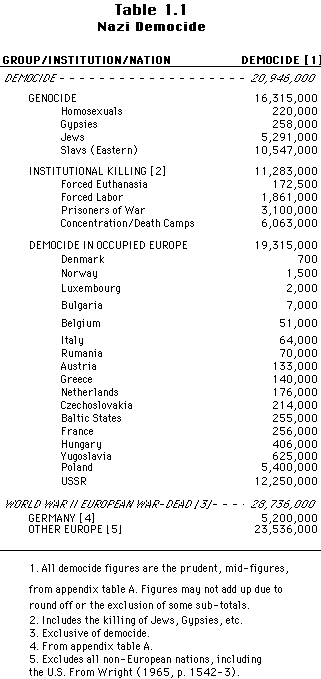
That said, Hitler did not make any distinctions and, along with Jews, Gypsies, homeosexuals, people with disabilities, freemasons, and Jehovah's Witnesses, Hitler planned to exterminate eastern and  western Slavs. He actually killed twice as many Slavs as Jews, but still fell far short of his aim: Today there are about 200 million eastern Slavs, 78 million western Slavs, and 46 million southern Slavs.

And my final -- and probably most pejorative -- assumption was about the Eastern Orthodox church, but that was because I really didn't know a thing about it.  I knew Constantinople (now Istanbul) had been established in 330 CE as the "co-capital" of the Roman Empire, but after that it was a complete mystery.  Reading about, I found that the founding of Constantinople effectively split the empire in two, with western Europe dominated by Rome and the Catholics, and eastern Europe (or the Byzantine empire) by Greece and the Eastern Orthodox Church. While the western Slavs became part of the Roman empire, the eastern and southern Slavs were under the Byzantine emperor.  I read an interesting description of the differences here (albeit from an Eastern Orthodox perspective).  I also learned "orthodox" means "correct" -- as in the correct way to worship.  Eastern Orthodox felt Roman Catholics had gone astray, and they were practising the "one true way" to worship.  And I found out that an uneasy truce lasted until 1054, when at a meeting members of both churches tried to excommunicate the others, resulting in a permanent split.

.However, and more relevant, I learned that I hadn't learned a thing about Eastern Orthodox, because I was in Catholic chuirches!  So I've had to uncheck eastern Europe from my to-do list, and one day I will actually explore the area.  (Here is one way to see it.)

Sunday, January 1, 2012

2011 in review

Honestly, I'd like to pretend this year never happened. My primary accomplishment, after spending three years convincing Jess to marry me, was to leave her. My therapist thinks I'm nuts.

Yhe year started with me getting a painful lesson in the UK house buying process, which finally concluded end of February. Then we spent two months gutting the house--that wasn't the plan, of course, but as we moved from room to room stripping layers of wallpaper, we found the walls were crumbling beneath. In the end, we replaced every interior wall except one!

Fortunately our contractor was an absolute dream, and in 8 weeks the house was put back together--with new bathrooms, a new kitchen, new plumbing, new heating, new electrical, new flooring, new windows, and a new patio door--and we moved in end of April. Now whether it was the stress of the renovation, or just underlying issues, Jess and I were hardly speaking, and I finally realized it was always going to be like this, every little argument spinning out of control, and I couldn't live that way.  So I moved out three weeks after we'd moved in.  (You can draw a lot of comparisons to the B&B, but don't.)

I spent a couple of weeks back at the hotel where I started, and two weeks in the States, just trying to figure out what was next. I didn't want to leave England--I only have two more years to get my "indefinite leave to remain" (equivalent of a green card) and if I leave now, the new immigration rules would prevent me from ever moving back!

But I also didn't want to be in London--too many memories, I guess, plus my work didn't require me to be in London, so paying London rents was crazy.  I looked at a map and Reading (pronounced "Redd-ing") seemed like a good alternative. I rented a flat overlooking a park and the Thames river, and moved in 21 July.

I was actually afraid to leave London, worried I was going to feel lonely and isolated. To counter that, I got a fish tank and started dating online. I met a lot of people, except none of them lived in Reading! I was driving an hour each way for every date! After a month of that nonsense, I started dating one girl exclusively. She lived in north London, not too far from Jess. And she was a South African Jew, just like Jess. And everyone who saw her told me how much she looked like Jess.  I didn't see it at all.

We dated for about three months, had a lovely trip to Cape Town, and she was present at my conversion, and though I quite liked her, I really didn't see the relationship going anywhere. We split just before Christmas, which was kind of a stupid time to break up. I plan to start dating again in the new year, and will try to be a little more discriminating, at least about location.

I was hoping to visit my family over the holidays, but airline prices were sky high (excuse the pun).  Since I already had the time off, though, I looked at a map to see how far my frequent flier miles would get me, and that turned out to be...Prague. I went with a jaded (and naive) American belief about all Communist countries--drilled into me from an early age--and I couldn't have been more wrong. I think it was the prettiest city I've ever been to. Four days wasn't nearly enough, and I will definitely be back. (Hopefully next time with someone else, or at least my good camera!)

Ironically, I'm spending New Years back at the hotel where this all started--the owner has become a very good friend--and I may brave central London to see the New Year's parade tomorrow. 

Plans for 2012 include a trip back to visit my family soon, plus my cousin is wants me to come to South Carolina for her daughter's wedding in April. I will try to visit Ireland and see my friend Kim in Amsterdam, both three years overdue. Also, for whatever reason, the sun has an 11-year-cycle which means 2012 will have an unusual amount of solar flares, so I will try to finally see the Northern Lights.  (5 weeks of holiday is fantastic!)

I'm also starting to get involved with my synagogue, and meeting people that way. (I would probably get even more involved if it weren't half an hour away.)  Financially, I should be out of debt by July and my job is going well, and the company seems stable, so probably no changes there.  I have one pair of tickets to the paralympics, and none to the Olympics, so that is going to be a washout. (At least I'm not living in London, so won't have to deal with all the tourists.)  I have a vague and ongoing resolution to lose weight and reduce my carbohydrates.

I also know two couples who recently moved to London, doubling the number of friends I have here!

So that's my 2011 in a nutshell.  Now I just need to put this to music and puppets...

http://sendables.jibjab.com/originals/2011_buh_bye?cmpid=yir2011_url

Happy new year!
  -Gregg

Saturday, December 31, 2011

Prague photos

Photos (and some short videos) are now online.

Friday, December 30, 2011

A (very brief) history of the Czech Republic

This story begins not with a conquest or a hero, but with a mass migration.  Between 500 and 900 CE, after the Western Roman empire had collapsed, there were several great migrations -- the Huns moved from Asia into Europe; in Germany, the Franks moved to France, the Lombards went to Italy, while the Angles and Saxons moved to England; the Hungarians came out from Western Russia; the Turks spread across Central Asia; the Slavs came out from modern-day Ukraine; and the Vikings went practically everywhere.

Many of these cultures, such as the Huns, were little more than raiding parties, disrupting life and then disappearing -- or being absorbed -- as quickly as they came. The Slavs, by comparison, were relatively peaceful, often moving into land abandoned by people fleeing the Huns!  They had their own culture and language, but not a written alphabet, and so little is known about them before the 6th century.  They spread out to cover all of central and eastern Europe, including Russia, the Balklans, and parts of central Asia.  Today there are more than 400 million Slavs.

In the 9th century, they started forming their own city-states, including Greater Moravia, which was a vassal state to Charlemagne's Holy Roman Empire. They adopted Christianity and monks Cyril and Methodius adapted the Greek alphabet to the Slav language, creating the Cyrillic script which is now the basis for all Eastern European languages.

Not long after, Moravia was overrun by Hungary, but Bohemia rose in its place. (One of the dukes of Bohemia was immortalized in the song "Good King Wenceslas" even though he wasn't a king, and the song had no relation to his life whatsoever.)  Things continued quietly until 1346, when Charles IV of Bohemia was elected Holy Roman Emperor, and he made Prague the capital of the empire.

He founded Charles University, the 11th oldest university outside of Italy.  He also founded New Town (Nové Město), rebuilt Prague Castle, began construction of St. Vitus' Cathedral, and established a new bridge (now called Charles Bridge).  Charles' reign was the "golden age" of Prague, even though many of the building projects he begun were not completed until the 19th century!

Unfortunately for his son, in 1415 Czech priest Jon Hus was burned at the stake for protesting against the doctrines of the Catholic Church.  This was over 100 years before Martin Luther nailed his Ninety-Five Theses on the door of All Saints' Church, sparking the Reformation.  The Hussites, as his followers were called, began a 200-year war with the Catholics, each one throwing the other out of the country (and occasionally out of windows), and then being thrown out in turn.  The Catholics finally won in 1620, evicting all Protestants from the country.

Bohemia was still a vassal state, first to the Holy Roman Empire, then to its successor, the Austrio-Hungarian empire.  After World War One, Czechs and neighboring Slovaks joined forces to become a single, independent nation for the first time in its thousand year history. Unfortunately, that only lasted 20 years.

During the Hussite wars, the Holy Roman Emperors had invited Catholic Germans to settle in the Bohemian and Moravian border regions, which now constituted nearly 20% of the Czech population.  In 1938, Adolf Hitler demanded these areas ("Sudetenland"), be re-united with Germany and all Czech residents expelled.  Hoping to appease Hitler, Italy, France, and Britain signed the Munich Agreement, and British Prime Minister Neville Chamberlain famously announced, "There will be peace for our time."  A year later, Hitler took the rest of Bohemia and Moravia, while Hungary took Slovakia.

After World War II, in 1945, Czechoslovakia became an independent state again but, disillusioned with the West and allied with the Soviets (who had told the American troops to wait for two days so the Soviets could be seen as the liberators), the Communist party was elected to power, and one of its first acts was to expel all Germans and confiscate their land.  Three years later, in a coup d'etat, the government suspended elections, creating a dictatorship.

In the early 1960s, the Czechoslovak economy stagnated. The industrial growth rate was the lowest in Eastern Europe and, in 1965, the party introduced free market elements into the economy.  The first secretary carried the reform movement a step further, lifting censorship and setting guidelines for a modern democracy that would guarantee freedom of religion, press, assembly, speech, and travel.  That was too much for the Soviets, and on the night of August 20, 1968, the first secretary was arrested and Soviet troops invaded Czechoslovakia, driving tanks down Wenceslas Square.  The bullet holes in the National Museum are still visible.  The government was forced to sign an agreement allowing Soviet troops to remain, and all reforms were repealed.

A few months later, student Jan Palach set himself on fire in Wenceslas Square in protest.

In 1988, Mikhail Gorbachev was advocating "Perestroika," which in many ways resembled the free market reforms of Czechoslovakia's 1965 plan.  Perhaps as a result, Czech leaders were reluctant to implement the changes, leading to widespread, but peaceful, protests.  On 17 November 1989, the police violently broke up a peaceful demonstration, brutally beating many students. Faced with an overwhelming popular repudiation, the Communist Party collapsed, its leaders resigned, and playwright Václav Havel, who had spent many years alternating between denouncing Communism and being in prison, became the new president. The "velvet revolution" was over in less than six weeks, without a shot being fired.

(Although Václav Havel was not a great politician, he was greatly loved for his steadfast opposition to communism.  When he passed away last week, he was given a state funeral, and in several of my photos you can see the candles placed all over the city by his loyal followers, especially on Wenceslas Square.)

Unfortunately, the past 40 years of Communist rule had heightened ethnic tensions between the Czechs and Slovaks, and on January 1, 1993, Czechoslovakia was dissolved and the Czech Republic and Slovakia were founded. It has become known as the "velvet divorce."

Over the past 20 years, the Czech economy has done quite well, with a GDP per capita of 80% of the European Union average. It is one of the most stable and prosperous of the post-Communist states, and was the first former member of the Soviet States to achieve the status of "developed country."  (Russia is still considered a "developing country.")  The country has the highest human development index in Central and Eastern Europe, ranking #27.  (The UK is #28.)  The Czech Republic as a whole generally has a low crime rate, is ranked as the third most peaceful country in Europe, and is the most democratic.  Prague airport is the busiest airport in Central and Eastern Europe. They have completely opened their borders and in 2007 joined the World Trade Organisation. They have yet to adopt the Euro, but may do so in 2013.

The 2011 population is 10.5 million and is one of the least religious populations on the planet, with 70% identifying as atheist, less than 10% as Catholic, and 2.5% as Protestant.  In 1930, there were 118,000 Jews in the Czech Republic. In 1945, there were approximately 4,000.  The number has not increased appreciably in the past 65 years.

Czech has a rich tradition in music (including Antonín Dvořák), literature (including Franz Kafka), and theatre (especially marionettes).  Gregor Mendel, the father of genetics, was a Czech friar, and Czech scientists created contact lenses and the plastic explosive Semtex, popular with terrorist groups.  A Czech author gave us the word "robot" from the Old Church Slavonic rabota, meaning "servitude."

The Czech Republic has the highest beer consumption per capita in the world. In 1840, a pale lager was developed in the Bohemian city of Plzeň, although in the States it is more popularly known by the nearby town of Budweis, or Budweiser Bier.

(Special thanks to Wikipedia, which is always a source of way too much information.  It took me nearly six hours to distill the history of the Slavs, the Roman empire, the Eastern Orthodox church, the Holy Roman Empire, the Austrian and Austria-Hungary Empire, the Nazis, and the Communists into this "brief" history.  I did learn, however, that the "Rus" in Russia refers to Vikings who helped liberate the Eastern Slavs from the Khazars, a group of Turks who had converted to Judaism!)

Thursday, December 29, 2011

A fine walk

I'd walked all day today -- from about 11am to 7pm -- and had come back to the hotel for a short rest.  Around 8:45pm, I decided to reward myself with some tea and cake.  (You have no idea how hard it is to get a good cup of tea in Prague is, or how addicted I've become.)  So I set out for a cute little bakeshop I'd seen near the Spanish Synagogue, on the opposite side of town.  I got there at 5 minutes past 9, and of course they had just closed.

So I struck out to find another place, and ended up walking over 4 miles, and an hour and a half, before I finally found someplace -- about 5 minutes from my hotel.

It was now 10:45pm, and most of Prague had shut down, but the sign on the Cafe Louvre proudly said it was open until 11:30pm.  A waiter promptly told me they were closed.  I pointed to the sign and got a long explanation, the jist of which was that 11:30 was when the waiters went home, so the customers had to leave sooner.  I said I just wanted tea and cake and he gruffly pointed to a table and told me to "hurry" (seriously), and then completely ignored me for 10 minutes!  Not even a menu.

Finally I got served.  5 minutes later I got the bill.  5 minutes later they started turning off the lights.  It was still 20 minutes to closing!!

Needless to say, I was not impressed and I'd say I wouldn't go back, but in fact I'm leaving tomorrow, so I'd say that even if it was wonderful. (And the black forest cake was quite nice.)  I do hope I come back--the town has been absolutely enchanting.  Truth be told, if I'd realized how beautiful it was, I probably wouldn't have come on my own.  (And I certainly would have brought my good camera!!)

But perhaps it is for the best--next time I can impress someone with my knowledge of Prague and the Czech language -- dobrý den, prosim, děkuji, a nemluvím česky.  (Hello, please, thank you, and "I don't speak Czech.")  I just have to find a better hotel.

Wednesday, December 28, 2011

Prague

I haven't written, only because there is too much to write about!  I want to talk about the castle, Old-New synagogue, Wenceslas Square, Charles Bridge, Hussites, the astronomical clock, St Martins-in-the-wall, Muchas, Terezin, communism, Prague Spring, pilsner beer, and bohemian crystals. and the museum of sex machines.  I want to complain about the food, the bell tower directly outside my hotel room, and the fact that the National Museum closed six months ago...for a five-year restoration.

And I'm sure I will say all that, but first I have to recant something I said years ago:

I said people travel primarily just to say they've been somewhere.

At the time, I could not think of any reason people spent so much money and endured all that hassle to go someplace they could learn more about by reading books (or now on the Internet).

But now I realise that travel does more than inform, it forces you to confront your assumptions, cultural bias, experience, and history.  It is a prism to re-evaluate your beliefs, and to let go of some stereotypes. It is a bridge to peace.

Growing up in the States, I never imagined I'd ever visit eastern Europe. When the Berlin Wall fell, I was just as surprised as the US President.  Coming to Prague, though, was such a revelation.  I expected to find grey skies, grey houses, grey food, and grey people, all in a listless shuffle. I didn't expect to find exquisite architecture from the 12th to the 19th century, squares filled with Christmas trees, and warm people who spoke excellent english. I also didn't expect to find a serious graffiti problem.

But more than that, what I didn't expect was to challenge all of my Western norms.  But to understand that, I've got to cover the history of Prague...

Sunday, December 25, 2011

Day one

Day one in Prague, not in my life.  I'm not sure if the public transport is free on Christmas eve, or if I've already committed my first criminal act. I should probably find out where the American embassy is. Just in case.
My hotel is a concrete monument to 40 years of Communist rule, now painted pink and green a la Miami Vice. Bare bulbs would be an upgrade, the view is of the building across the street, and the only thing thinner than the mattress is the carpet. For £24/night, I wasn't expecting much, but I love it! Not only does it ooze character, but it also has a massive radiator, free WiFi, Free breakfast, and a private bathroom! (Odd they did not mention that on the web site.)  This is much better than my austerity measures planned for.
Also unexpectedly, all of the restaurants have vegetarian options! Unfortunately, it being Christmas eve, most of them are closed, and the few that are open have a set menu that is pretty consistent: Wild boar or hare pate, beef goulash soup, and a fish main.
I had pizza.
Walking around town, though, is magical. It's cold with an intermittent drizzle, but sadly no snow. The streets are mostly deserted, with more people in the touristy area. Someone at Heathrow told me that in Europe, Christmas is Christmas eve, meaning that's when everyone gathers for family meals.  I'm hopeful I can find a midnight mass to attend.
And I'm hopeful I can find my way back to the hotel!

Friday, December 23, 2011

Prague

I'm off to Prague for Christmas.  Why?  No reason.

Of course I'd rather be with my family, but the airlines know this and so doubled the cost of flights, making it unaffordable.  But while I was despairing at flights across the pond, the British Airways web site showed me I could go anywhere within a 2 hour radius for only 9,000 frequent flier miles (and £27).  And the furthest I could go was Prague.

The capital of the Czech Republic (and what was Czechoslovakia before Slovakia became a separate state) came out from the iron curtain in 1989,  looking very much like Miss Haversham in her 50-year-old wedding dress.  (Dicken's Great Expectations--this being England, I've been pummeled with Dickens over the past two weeks.)  What was once the proud capital of a thriving European country had been reduced to a drab and grey little town.  However, over the past 20 years the grey has given way to pastel, tourism is thriving, and because it's not part of the European Union yet, everything is dirt cheap.

In addition to the £27 flight, I'm paying £24/night for a 3-star hotel, including breakfast, in the middle of town!  The bus from the airport costs 90p, and food won't cost anything because it's eastern European, so all they will serve is meat.  I suspect I will be eating eggs every day for a week.

But I can't wait to visit the Jewish Quarter, the castle, the art galleries and museums.  I plan to dress warm and walk everywhere, especially along the river.  I just hope there is snow.

But what is really interesting is that it will be the first time I've ever traveled by myself.  All of my trips have either been with someone, or to see someone, or for work.  I'd never taken a gap year, and I've always been in relationships.

In Judaism, there is a blessing for the first time you do something (in your life or in a season), called the Shehechiyanu.  It translates to:

Blessed are You, Lord, our God, Ruler of the Universe, who has granted us life, sustained us, and enabled us to reach this occasion.

It is one of my favorite prayers (right up there with the prayer on seeing a rainbow) because it is a recognition of all the wonderful experiences all around us.  I said it for the first time earlier this month, as part of the conversion ritual.  I will say it again when I land in Prague, partly because it will be my first visit to the city, partly because as a Reagan child I never thought I'd see Eastern Europe in my lifetime, and partly because it will be my first trip on my own.

But mostly I'll say it because I'll be happy to get off the airplane.  Who knows what kind of World War II bucket I'll get for 9,000 frequent flier miles?

Music trivia

I've managed to waste about two days on something that should have taken ten minutes, and really shot myself in the foot in the process.

All I wanted to do was backup my music.  I hadn't done so in quite some time, and had recently ripped a bunch of CDs.  My first thought was just to backup to two DVDs, which would have taken just a few minutes, but there would be no way to sync them.  Plus, that was decidedly uncool.

So I started looking at online storage options, such as Google Music, Amazon Cloud, Microsoft Skydrive, and iTunes Match.  Online file hosting is certainly not a new idea, but it's always been very slow, clumsy, and expensive.  I was hoping these new services would be better.

I needed about 8GB to save all of my songs.  Google Music offered 15GB for free, but it immediately told me it wasn't available outside of US.  (Obviously it is very annoying when the UK is treated as a second-world country, but at least there is an ocean between the two countries -- I wonder how Canadians feel when they see this message?)

Amazon was a second choice because it only offered 5GB free--I had to pay for the rest--but it assured me their cloud was available in the UK.  I signed up but for the life of me I couldn't figure out how to upload files.  After 20 minutes, I finally tracked down a help file that told me I had to open the music player to find the "upload button."  I downloaded and installed the music player, found the upload button, and when I clicked it was told "This feature is not available outside of the US."

Microsoft Skydrive was my third choice because, although it offered 15GB for free, you can't upload folders!  They expect you to put everything into one big folder, which is ridiculous.  I did manage to track down a third party tool that let you upload folders and finally got that installed, told it to upload my 8GB, and it told me it would take 3 days and 4 hours.  After about 20 minutes, I cancelled it.

Finally, iTunes Match, which offered nothing for free -- it's $25/year in the States and £21 in the UK -- but had two big advantages:
  1) If it "matched" your song with one it already had, it didn't need to upload it; it just created a link to it.  Thus, it wouldn't take 3 days to upload everything!
  2) Once it matched, you could replace the song on your hard drive with the official Apple version.

The second bullet really appealed to me because four years ago, when I ripped most of my CDs, hard drives were considerably smaller and so I saved everything at 56 kbps, whereas Apple used 256kbps.  Now, I don't know that the quality makes that much of a difference -- I certainly never noticed anything -- but now I had plenty of space on my hard drive, and this was an easy way to update my songs, so I signed up.

After Apple took my money, of course they told me the version of iTunes I was using was out of date, and I had to update it.  Once that was done, it set of to match my music and, of the 3,500 songs I owned, it matched about 150.

Seriously, 150.

Even more disturbing, it had put a little cloud icon with a line through it next to most of my songs, and when I clicked on it, it just said "ineligible."  I had no idea what that meant but a little googling uncovered a note that said iTunes would not match music recorded at less than 92kbps!  That was the reason I had given Apple £22!

I looked around at programs that would "convert" files to a different bandwidth, but most of them cost around $20. (One of them indicated it was free, let me install it for free, and only when I told it to convert a song did it tell me it would convert HALF the song for free, but if I wanted the whole song I had to pay.)  Plus I realised if I did that, I would lose all of my stats and ratings in iTunes.  I was not happy.

The solution, ironically, came from iTunes itself.  Originally, iTunes sold songs that had "DRM" to prevent copying.  When they finally introduced DRM-free music, they added an option to create an MP3 version so you could jailbreak your old songs.  Now, all of my songs were already MP3, but iTunes wasn't smart enough to realise this, so it let me create a new MP3 version and, critically, the new one was 128kbps (and kept the stats and ratings).  So I told iTunes to create MP3 versions of all my MP3 files, then told it to match the new 128kbps versions, and it matched about 3,000 of my songs.

Then I deleted all 6,000 of those songs (since I had two versions of each) and told Apple to download them again, thus getting the clean 256kbps version.  (Fortunately it's a lot faster to download than upload, and only took about six hours.)  There are still 400 songs it refuses to match -- and it's very random, with one or two songs on an album, and the rest are fine -- but that's good enough for me.

If this all seems a bit ridiculous to you, it's because it is.  Nothing in life should be this difficult, and I realize it's only because I know enough about technology that I can possibly make things this complicated.

But it gets worse.  Because of the higher quality, my 8GB of music is now 25 GB.  That's not a problem on my hard drive, but when I went to copy the songs to my phone -- which only has 2GB of space -- I could only copy one-third of the music I used to!  I completely forgot that on my phone -- and my old mp3 player -- file space is still an issue!!

Unfortunately, there's no easy way to get back to the 56kbps versions, so I'm stuck.  But at least I've backed up my music collection, which is really all I set out to do.